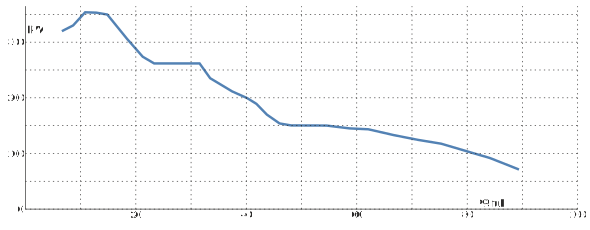
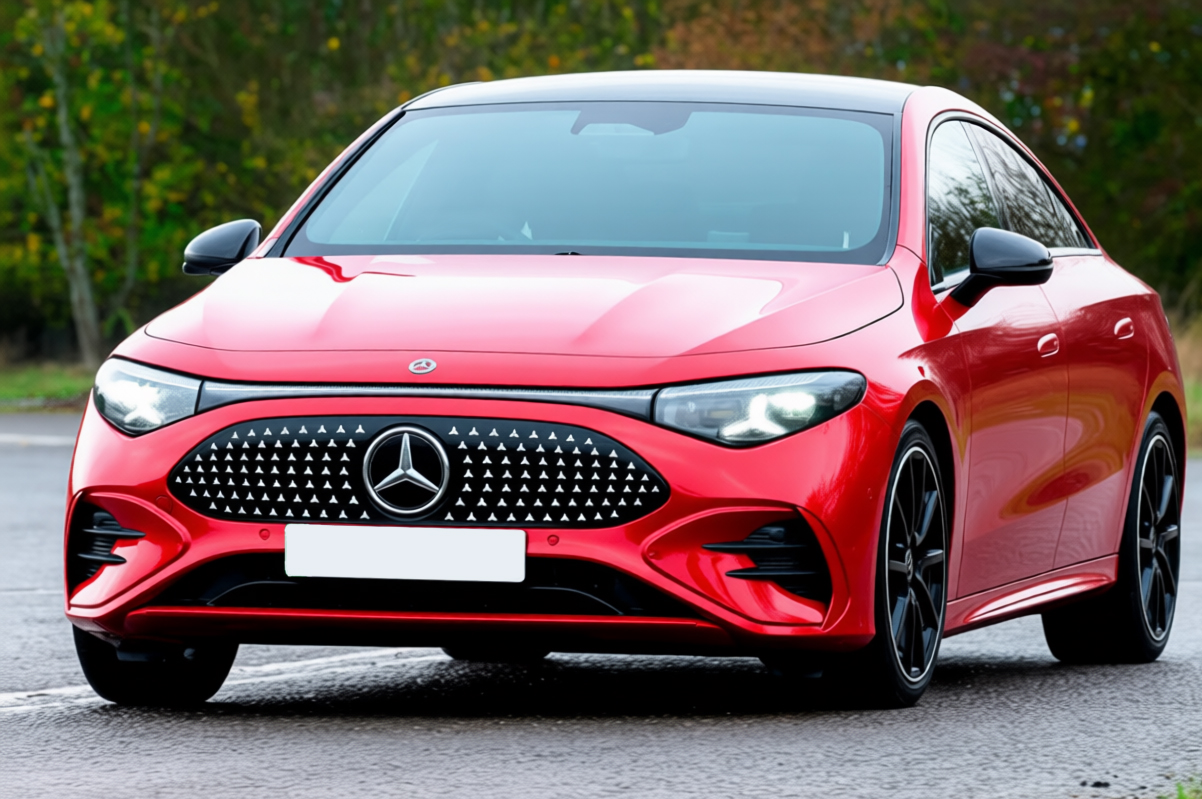
Mercedes CLA 250+ EQ
Mercedes new MMA (Modular Mercedes Architecture) platform will become the foundation for all future compact electric and hybrid models, including SUVs. This has enabled an entirely new, significantly more efficient powertrain. This development project is the result of the joint work of the German manufacturer and the Chinese BAIC group, with whom Mercedes has been collaborating since 2005. The CLA is the first car to implement the MMA, and in this case, it includes a two-stage gearbox (ratios 11:1 and 5:1), as well as safer 85 kWh and 58 kWh batteries (in the 200 CLA model).
With the new CLA, Mercedes has made a significant step forward by transitioning to an 800V system. A higher voltage means less heat and thermal losses, as well as thinner and lighter conductors. This allows for extremely fast charging on some chargers. Additionally, the CLA has exceptionally low air and rolling resistance and an efficient drive system, which addresses the main issue of electric vehicles: the ability to cover long distances in a shorter period.
BUILD QUALITY
At first glance, the interior gives the impression of good quality. Everything is precise and well-secured (a significant improvement over the old CLA). However, cost-cutting (despite the high price) is evident in some areas. The lower part of the doors and the space beneath the dashboard are made of hard plastic, which is poorly finished in some places. This is particularly noticeable on the glove compartment, which is also quite small. Even the B-pillar is not upholstered, and the seat belt is not height-adjustable.
Higher trim levels include attractive decorative strips and ambient lighting, which extends to the air vents and will appeal to younger buyers, whom Mercedes is targeting with the CLA model. I must note that at night, the illuminated air vents create reflections on the glass, which can be a distraction while driving.
Overall, the materials are not bad, but for this price, it’s reasonable to expect more. The steering wheel and stalks are also better than the previous model, while the somewhat flimsy seat adjustment buttons on the doors and the noise from the motor in the seat during adjustments do not convey a sense of luxury and refinement.
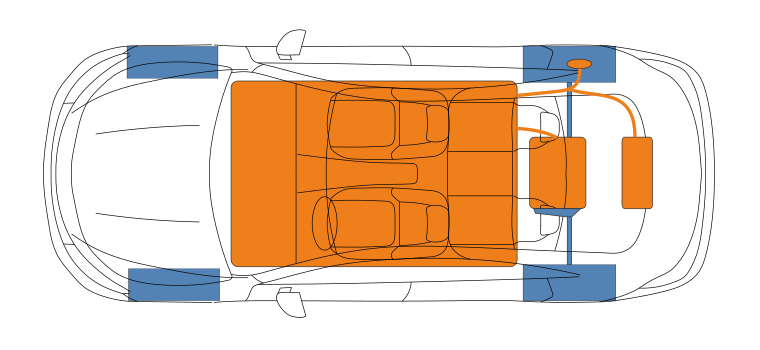
From the outside, everything looks as it should. The panels are precisely made, and the gaps between them are small and consistent. Everything is in place. They may have tightened the standards here to achieve a low air resistance, which is a highlight of this model. Great attention has been given to the underbody, where aerodynamic plastic covers are visible even beneath the rear suspension.
The sound of the doors closing is somewhat disappointing for this price range. The warranty for the battery is 8 years (or 160,000 km), but for the rest of the vehicle, it is only 2 years.
PRACTICALITY IN EVERYDAY USE
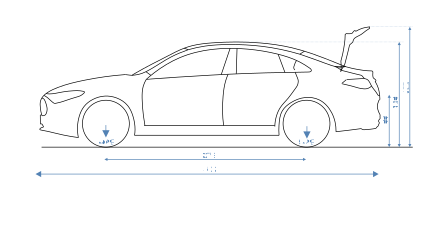
With a length of over 4.7 meters, the car is at the borderline of what’s acceptable for city driving. While traffic congestion and maneuverability might not be an issue, parking spaces could be a problem.
The maximum load capacity is sufficient for four adults with plenty of luggage, but a roof rack is not an option since the roof is not designed to carry any load. The maximum towing capacity with brakes is 1.5 tons (750 kg without brakes), and the hitch can support up to 80 kg, which is enough for a carrier for two or three bicycles. The car comes with run-flat tires and does not have a spare tire, not even as an option.
LIGHTING AND VISIBILITY
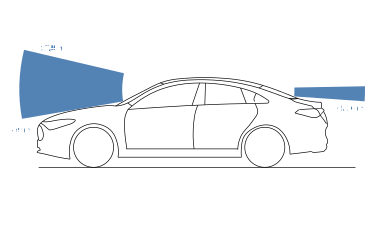
Visibility is not particularly good because the car has a coupe-like design, which results in thick A and C pillars, and the seating position is low. Designers had to make some compromises for aerodynamics. When turning in tight spaces, it’s not entirely easy to determine where the front end of the vehicle ends. Moreover, it’s quite surprising that front and rear parking sensors are not part of the standard equipment(!). There’s only a rear camera, and the 360° camera is again an optional extra. The high rear window sill can be forgiven, especially since the rear headrests do not lower as they do in some other Mercedes models.
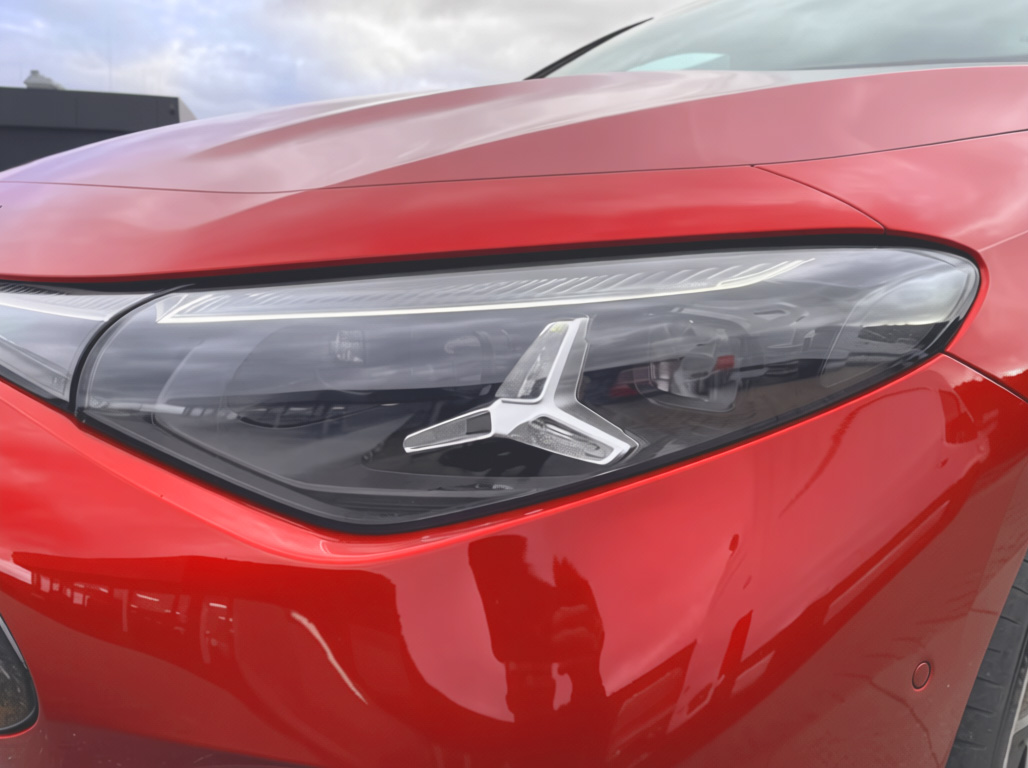
The headlights are fully LED and of good quality, but they could benefit from a washing system, especially in winter, which is absent. The beam height adjusts automatically. Multibeam (matrix) lights are available as an optional extra and have 24 modules on each side.
The exterior mirrors are slightly reduced for aerodynamic reasons, but they are still good. They lack auto-dimming, which is only present on the interior rearview mirror. The wipers are very good, with washers integrated into the wiper arms and extended operation of the right wiper thanks to an additional joint in the mechanism.
POWERTRAIN
The performance is really good, with strong acceleration at any moment, and the response is instantaneous, typical for electric cars. The maximum speed is limited but not excessively so. Acceleration is particularly strong at low speeds, making it easy to merge into traffic.
The powertrain produces no vibrations or unexpected noises. Between 110 and 120 km/h, the car shifts into the second gear, and at that moment, a slight pause can be felt. The vehicle continues to accelerate satisfactorily but not as energetically as up to 110 km/h.
CHARGING
Charging at fast stations is somewhat limited because the CLA currently supports only 800V chargers. The Shooting Brake version offers an option for 400V charging (for an additional cost), but even then, the maximum charging speed is capped at 100 kW. It’s said that units produced later in 2026 will come standard with 400V charging support, but there is no upgrade option for existing models. The 100 kW limitation will likely remain. Fortunately, the CLA EQ has a very good range.
Home charging on a regular outlet takes almost two full days, while using a wallbox (11 kW) takes about 9 hours.
TRANSMISSION
Unlike most electric cars that have a single-speed transmission, Mercedes has opted to use a 2-speed gearbox to simultaneously increase range and improve acceleration. During strong acceleration, between 110 and 120 km/h, it feels as if you briefly let off the gas pedal. It’s not significant, but it can catch you off guard the first time, especially since it’s an electric vehicle.
The car doesn’t have a start button; once you sit behind the wheel, you simply need to switch the lever on the steering column to D or R to start driving. After stopping, you leave the car in P, and the systems will shut down once you lock it. You can also “turn off” the car without exiting by double-pressing the P button on the stalk. The same lever is used to adjust regeneration, which has 4 levels. Regeneration can be as strong as 200 kW, significantly contributing to the vehicle’s range, but it sometimes feels like it doesn’t work as smoothly as in some other models, acting independently of the driver’s gas and brake inputs. This is likely because the automatic mode monitors traffic and activates regeneration accordingly requiring some time to adjust and adapt one’s driving style.
DASHBOARD
Most functions are controlled via the central screen. The screen is large and sharp, mostly operating smoothly. The main instrument display (in front of the driver) is also sharp and measures 10.25 inches. Unfortunately, quick access buttons for the main menus or functions no longer exist. The problem is that the central screen, due to its size (14 inches), is quite far from the driver, making it impossible to reach functions on the right edge of the screen without leaning forward in the seat.
Volume is adjusted exclusively via the steering wheel or the screen. The steering wheel has touch-sensitive (capacitive) buttons instead of physical ones, which in this iteration are somehow even more sensitive and harder to control. It’s entirely expected that you’ll accidentally activate something or change the radio volume while driving. Fortunately, Mercedes has announced that the CLA will receive a slightly revised steering wheel with a physical wheel on each side, and the Shooting Brake version will have this upon market release. This will only partially improve the situation since the other buttons will remain touch-sensitive. Besides being easily activated accidentally, the touch buttons on the steering wheel require extra concentration on the screens and are distracting in traffic. Voice commands work well, but they can’t replace physical input. The screen displays are visible in all conditions, both day and night, but the lack of physical buttons is inexcusable. Additionally, functions like mirror and window heating are buried deep within menus. The level of automation is good, and the vehicle manages some things well, but overall, the interface is overly complicated—at least until the driver gets accustomed.
The vertical dashboard with a single large piece of glass reminds me personally of something archaic and cheap, and I’m not thrilled with the cockpit design. However, it should be noted that the “Superscreen” with three large screens under a single piece of glass looks better and less intrusive in person than in photos.
The electronic parking brake button is unnecessarily placed in Mercedes’ traditional location (to the left of the steering wheel), preventing passenger intervention if needed. The right end of the central screen isn’t easy to reach from the driver’s seat without leaning forward.
The door panel for window control is also awkward. There are only two controls for opening all four windows. We’ve seen this on models from some other manufacturers, but such cost-saving measures are unexpected from Mercedes, especially at this price point.
MULTIMEDIA
The CLA comes with a decent audio system and, of course, Bluetooth connectivity. The navigation system includes real-time traffic updates, and for an additional cost, it offers augmented reality navigation, as seen in some of the more expensive Mercedes models. Instead of a map, the screen displays a live feed from the windshield camera, augmented with street names and navigation instructions. The voice recognition system and communication with the GPS work well, and the HeyMercedes feature, which includes GPT capabilities, can be a somewhat entertaining companion on long journeys. It also suggests places to visit along the route based on Google reviews, understands naturally formulated queries and conversational language, and remembers recent conversation topics or searches, allowing it to follow up coherently. Fantastic! However, HeyMercedes can sometimes activate unintentionally during conversations with passengers and say that it didn’t understand the command, but it remains the best assistant available in cars.
Navigation routes will also indicate charging stations as needed. A unique feature is car-to-car connectivity, where the CLA communicates with other cars on the road (currently only with newer Mercedes models) to gather route data, including information about accidents, traffic jams, or adverse weather conditions like wind or ice.
Streaming from a phone via Bluetooth or a USB connection works, but Android Auto and Apple CarPlay are not part of the standard equipment and are available only as optional extras. The same applies to wireless phone charging, which is surprising given that many cheaper cars now offer these features as standard equipment.
Communication and vehicle control through a smartphone are available via the MercedesMe app. Multiple driver profiles can be set up and linked not only to the keys but also to phones, allowing each user to access their profile via their phone.
The speakers are of good quality, and the excellent Burmester system with 16 speakers and 850W of total power is available for an additional cost.
The passenger-side screen is not part of the standard package and is only available as an extra. The car also supports video calls via a built-in “selfie” camera, but only when the vehicle is stationary.
The wireless phone charger is generously sized, charges at 15W, and even features cooling. You can discreetly route a USB cable from the hard-to-reach USB port below the center console bridge if your phone does not support wireless charging.
DRIVING ASSISTANTS
The standard equipment includes features such as distance warning and automatic emergency braking, along with an adaptive cruise control system that takes navigation into account and adjusts speed for curves and turns, even when there is no traffic.
The Drive Assist package adds steering assist, which works quite well and allows for a form of autonomous driving. It’s definitely a helpful feature on the road. It also includes Lane Change Assist, which unfortunately performs poorly and is almost useless in heavy traffic conditions.
The evasive steering assist reportedly aids the driver in avoidance maneuvers.
The parking assistant works surprisingly well, but you may not need it if you opt for all the additional equipment. The 360° view is one of the better ones available. There are even two side cameras under each mirror. Speed limit recognition is part of the standard equipment, but alerts can be easily turned off via a button on the steering wheel or through voice control. Additionally, the system recognizes wrong-way driving and warns of approaching roundabouts.
The Drive Assist Pro package, in addition to all the above features, also reads STOP signs and traffic lights.
A heads-up display (HUD) is not included in the standard package, but it displays not only speed but also navigation instructions and speed limits, as is typical.
DRIVING CHARACTERISTICS
At higher speeds on straight roads, the vehicle’s stability is good, even when the road isn’t perfect. However, crosswinds are quite noticeable, and any change in direction causes slight body roll. Despite this, the handling remains unaffected. The electronic traction control is quite active at higher speeds, though drivers generally aren’t aware of it. This is likely due in part to tire choices aimed at efficiency and reduced consumption. The suspension is generally satisfactory, and thanks to electronic aids, the car behaves well at moderate speeds. However, during very fast driving with consecutive corners, it seems to constantly shift between oversteer and understeer as the electronics try to stabilize the vehicle, requiring more space in the curves.
STEERING
The vehicle responds with a slight delay to steering inputs. Feedback is minimal, often giving the impression that the steering wheel isn’t directly connected to the car, but steering is very precise. At higher speeds, the force that returns the steering wheel to the center increases significantly, but the lack of feedback while driving straight remains a problem. Because of this, and the fact that the steering is quite direct, highway driving at high speeds can feel a bit twitchy. The steering has 2.5 turns lock-to-lock and isn’t overly light. Adjustments through Dynamic Select may optimize these settings. Maneuverability in the city and tight spaces is very good for this class of vehicle.
BRAKES
The brakes require some getting used to because the pedal doesn’t provide good feedback. This is likely also influenced by the regenerative braking action. Once accustomed, the brakes work well and are easy to modulate. The braking force itself is very strong, allowing the car to stop quickly even from higher speeds. Auto hold is included in the standard equipment.
INTERIOR
FRONT SPACE
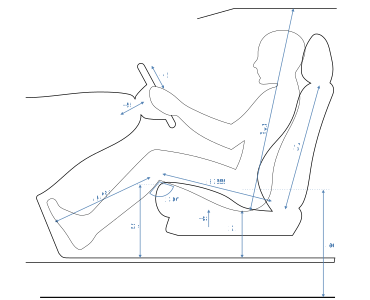
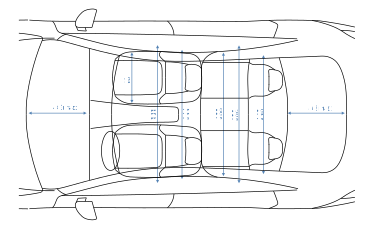
The space in the front is good, even for people over 2 meters tall. While getting into the vehicle might be a bit challenging, once inside, the seating is comfortable. Despite the spaciousness, the interior feels cramped due to the high window line, high-set cockpit, and dark headliner. Ambient lighting might slightly mitigate the claustrophobic feeling. The panoramic roof starts just above the heads of the driver and front passenger, so it doesn’t significantly impact the sense of space in the front.
REAR SPACE
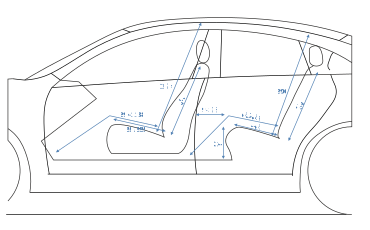
In the rear seats, the feeling of crampedness is less pronounced thanks to the panoramic roof. Unfortunately, the rear windows only roll down halfway due to the doors’ shape, a compromise for the attractive exterior design. There’s adequate legroom in the back (as long as passengers in the front are of average height), but headroom is limited, and those around 180 cm tall might have issues.
Despite a wheelbase that is 6 cm longer in the new model, the interior is not particularly spacious, and the car could be classified as compact. It’s comfortable for four people, but space is somewhat limited.
STORAGE COMPARTMENTS
The center armrest in the back is uncomfortable because the cup holders take up much of its space. The door pockets in the rear are not as large as those in the front, but they’re sufficient for a small water bottle. Instead of pockets, elastic nets are found on the back of the front seats—a clear cost-cutting measure!
In the front seats, storage is better, with good-sized door pockets and a compartment under the center armrest with dual doors that’s deep but not wide. The glovebox is smaller than expected and cannot be locked. None of the storage compartments are heated/cooled.
GETTING IN AND OUT
In the lowest position, the seats are 45 cm above the ground, which is relatively low, and the door openings are not large, making entry and exit challenging for older or taller individuals. Access to the rear seats is further hindered by the narrowed upper part of the door opening due to the sloping roofline. On the positive side, there is no central tunnel in the rear, making it easy to move from left to right seat, or vice versa. Both front and rear doors have three opening stages. Those accustomed to using grab handles for assistance in entering and exiting will be disappointed as none are available.
Keyless entry is not included in the basic model’s standard equipment—another unexpected area of cost-saving. Exterior lighting is good, with even the illuminating stars on the front grille offering assistance.
TRUNK SPACE
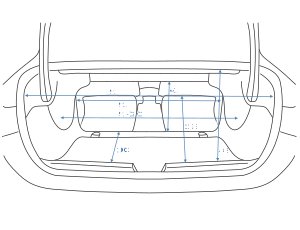
The trunk capacity is larger than expected, given the aerodynamic shape of the CLA, with about 10 liters of space beneath the floor. The front trunk (frunk) is the largest on the market at 101 liters.
The trunk lid, assisted by a spring, opens quite suddenly, but fortunately, its angle minimizes the chance of hitting you. For electric opening and closing, you’ll need a package that includes gesture control (foot motion under the rear bumper). A downside of the trunk lid is its size. While the trunk is satisfactorily sized, large items won’t fit due to the small opening. The trunk lip is quite high at 77 cm, making loading difficult, while the 18 cm high inner lip, although it doesn’t aid unloading, provides a feeling of security for stored items. The rear seats fold down in a 60:40 split but can only be done from the passenger area. When folded, the floor is somewhat flat but gently slopes at the rear seatback area. The trunk has only one light, but it’s centrally placed, which should be sufficient. The front trunk is also lit. Unfortunately, neither trunk contains any outlets. Given it’s an electric car, one might expect a 220V outlet, but there’s not even a 12V one.
There’s no provision for hooks for bags or securing cargo in the trunk, although the front trunk does have a net, which is at least something. The Shooting Brake offers significantly higher practicality for carrying luggage, albeit with higher consumption and cost.
COMFORT
For a vehicle to be suitable for long journeys, it needs to be comfortable, and the CLA manages this with some limitations. The space offered is in line with the class it belongs to, though it is somewhat compromised by aerodynamic considerations. The front seats are comfortable, but the rear seating area is cramped.
SEATING
The Mercedes-Benz CLA’s seating setup features a basic front row and a comparatively less cushioned rear row. The base “Progressive” trim offers standard front seats that provide acceptable comfort, though the adjustment options are somewhat limited. The driver’s seat has tilt adjustment (which was not available for the passenger side in the test vehicle) and electrically adjustable four-way lumbar support. The passenger seat also has four-way lumbar support, but accessing this function requires navigating through the infotainment menu, which can be inconvenient. The lumbar support massage feature is an optional add-on, while fully electric adjustment with memory settings for both front seats is available as another paid option.
The rear row offers less contouring and moderate lateral support compared to the front seats. Despite these limitations, rear passengers benefit from good legroom, making long-term comfort acceptable for most occupants. The front seats have a practical headrest adjustment mechanism, which, despite being manual, allows for adjustment even during driving.
SUSPENSION
The CLA’s ride quality is largely determined by its comfort-suspension setup, which Mercedes-Benz has tuned to keep road imperfections from intruding into the cabin. The CLA 250+ EQ comes with a comfort suspension as standard; no adaptive dampers are offered in this trim level. Engineers have achieved a very smooth ride: 17-inch wheels, together with the tuned chassis, absorb most bumps and potholes, even on uneven city streets. On highways, the suspension handles undulations well enough that long drives feel relaxed and quiet. While the comfort tuning provides a pleasant passenger experience, it also means that short, sharp bumps can feel a bit harsh because the firm setup has less compliance than adaptive dampers would offer.
AIR CONDITIONING
A surprising downside at this price point is that the CLA does not come with automatic climate control. You can set the temperature, but you have to manually adjust the fan intensity. Initially, it’s surprising, leading you to search through options and menus, assuming it must be available. Dual-zone Thermotronic is available as an extra option. Airflow cannot be controlled at the rear seat ventilation outlets, which is surprising given that this was possible in the previous CLA model.
Heated front seats are standard, while a heated steering wheel is available for an additional cost. Parking climate control is included in the standard equipment and can be pre-programmed or controlled via the Mercedes app on your phone. The panoramic roof, standard on all models, is only lightly tinted and lacks any shades, which could pose a problem on hot summer days.
INTERIOR NOISE
The interior noise level is not high, even though the windows are single-glazed. This is thanks to its good aerodynamics and the powertrain, as the motor is silent. The weak point is the panoramic roof, which generates some noise at high speeds. Road noise constitutes the biggest part of the noise level, meaning the final result heavily depends on the tires selected.
CONSUMPTION AND ECONOMY
The consumption of the CLA is the lowest in its class, comparable to the best performances of the Tesla Model 3, depending on conditions. Mercedes claims that the system’s overall efficiency (from charger to wheels) is as high as 93%. The declared range is 700 km, but this is achievable with eco tires, ideal temperature, and other favorable conditions. Realistically, you can expect to drive 450-500 km on the highway or with a heavy foot on the accelerator, while in urban conditions, thanks to the regenerative braking system that can peak at 200 kW, you might achieve 700-800 km.
The navigation system calculates optimal charging stops along the route, and if a charger is registered in Mercedes’ network, it can even reserve a spot, ensuring there’s no waiting time at the charger. Fifteen minutes before arriving at the charging station, the heat pump will prepare the battery to the optimal temperature so that charging can commence at full power immediately. The actual charging speed can reach up to 350 kW (exceeding the declared 320 kW!). In just 10 minutes, it’s possible to add as much as 300 km of range. Charging from 10% to 80% takes approximately 21-22 minutes.
Image Gallery




Technical Specifications
Dimensions

Driving & Visibility


Drivetrain & Suspension
Performance

Driving Dynamics
Comfort & Ergonomics
Costs & Efficiency